Monday, 5 January 2015

Addition of Alcohols to form Hemiacetals and Acetals


In this organic chemistry topic, we shall see how alcohols (R-OH) add to carbonyl groups. Carbonyl groups are characterized by a carbon-oxygen double bond. The two main functional groups that consist of this carbon-oxygen double bond are Aldehydes and Ketones.

Introduction

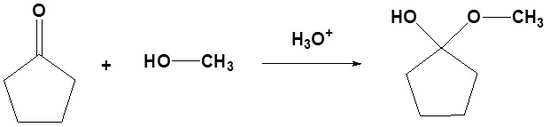
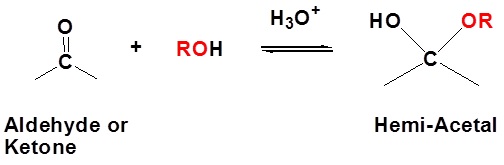
It has been demonstrated that water adds rapidly to the carbonyl function of aldehydes and ketones to form geminal-diol. In a similar reaction alcohols add reversibly to aldehydes and ketones to form hemiacetals (hemi, Greek, half). This reaction can continue by adding another alcohol to form an acetal. Hemiacetals and acetals are important functional groups because they appear in sugars.
To achieve effective hemiacetal or acetal formation, two additional features must be implemented. First, an acid catalyst must be used because alcohol is a weak nucleophile; and second, the water produced with the acetal must be removed from the reaction by a process such as a molecular sieves or a Dean-Stark trap. The latter is important, since acetal formation is reversible. Indeed, once pure hemiacetal or acetals are obtained they may be hydrolyzed back to their starting components by treatment with aqueous acid and an excess of water.

Formation of Hemiacetals

1.jpg
Example 1: Formation of Hemiacetals
2.jpg
Example 2: Hemiacetal Reversibility
 3.jpg

Formation of Acetals

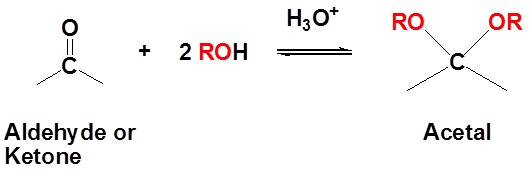
Acetals are geminal-diether derivatives of aldehydes or ketones, formed by reaction with two equivalents (or an excess amount) of an alcohol and elimination of water. Ketone derivatives of this kind were once called ketals, but modern usage has dropped that term. It is important to note that a hemiacetal is formed as an intermediate during the formation of an acetal.
4.jpg
Example 3: Formation of Acetals
5.jpg
Example 4: Acetal Reversibility
 6.jpg

Mechanism for Hemiacetal and Acetal Formation

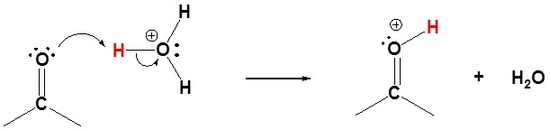
The mechanism shown here applies to both acetal and hemiacetal formation
1) Protonation of the carbonyl
7.jpg
2) Nucleophilic attack by the alcohol
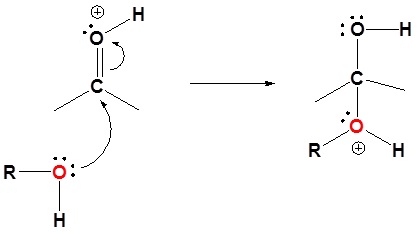
8.jpg
3) Deprotonation to form a hemiacetal
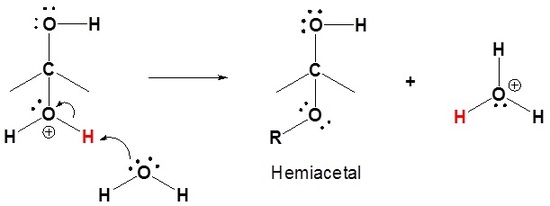
9.jpg
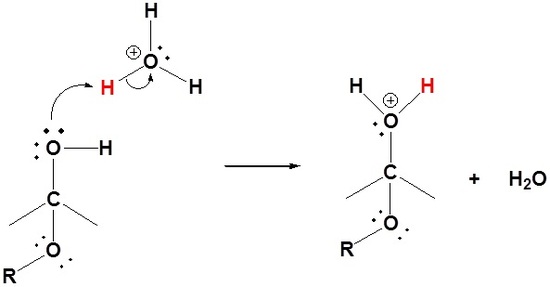
4) Protonation of the alcohol
10.jpg
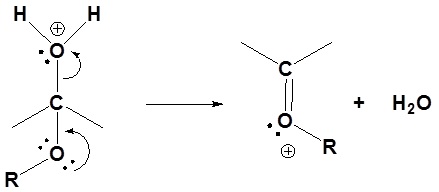
5)  Removal of water
11.jpg
6) Nucleophilic attack by the alcohol
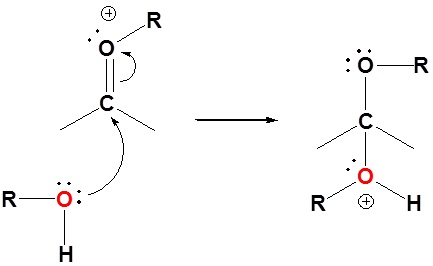
12.jpg
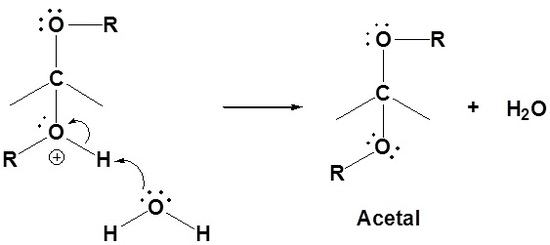
7) Deprotonation by water
13.jpg

Formation of Cyclic Hemiacetal and Acetals

Molecules which have an alcohol and a carbonyl can undergo an intramolecular reaction to form a cyclic hemiacetal.
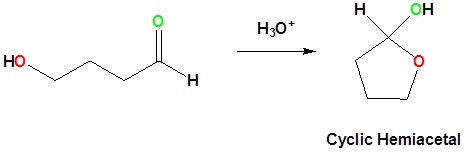
14.jpg
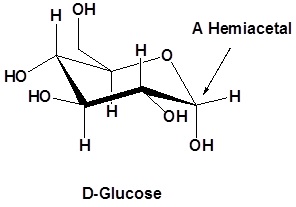
Intramolecular Hemiacetal formation is common in sugar chemistry. For example, the common sugar glucose exists in the cylcic manner more than 99% of the time in a mixture of aqueous solution.
15.jpg
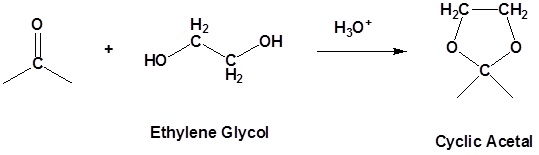
Carbonyls reacting with diol produce a cyclic acetal.  A common diol used to form cyclic acetals is ethylene glycol.
16.jpg

Acetals as Protecting Groups

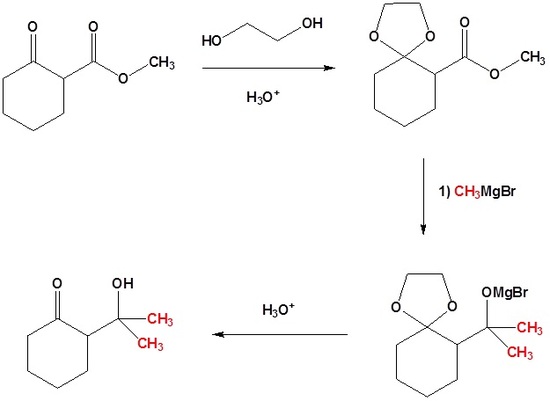
The importance of acetals as carbonyl derivatives lies chiefly in their stability and lack of reactivity in neutral to strongly basic environments. As long as they are not treated by acids, especially aqueous acid, acetals exhibit all the lack of reactivity associated with ethers in general. Among the most useful and characteristic reactions of aldehydes and ketones is their reactivity toward strongly nucleophilic (and basic) metallo-hydride, alkyl and aryl reagents. If the carbonyl functional group is converted to an acetal these powerful reagents have no effect; thus, acetals are excellent protective groups, when these irreversible addition reactions must be prevented.
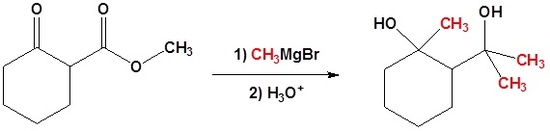
In the following example we would like a Grignard reagent to react with the ester and not the ketone.  This cannot be done without a protecting group because Grignard reagents react with esters and ketones. 
17.jpg

18.jpg


Addition of Water to form Hydrates (Gem-Diols)


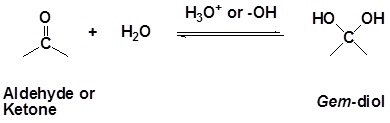
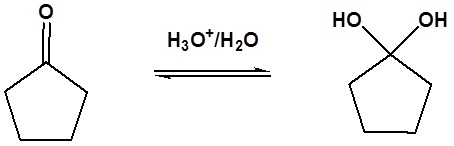
It has been demonstrated that water, in the presence of an acid or a base, adds rapidly to the carbonyl function of aldehydes and ketones establishing a reversible equilibrium with a hydrate(geminal-diol or gem-diol). The word germinal or gem comes from the Latin word for twin,geminus.

1a.jpg

Example 1
15a.jpg

Going from Reactants to Products Simplified


10a.jpg


Reversibility of the Reaction

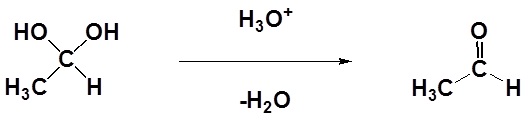
Isolation of gem-diols is difficult because the reaction is reversibly.  Removal of the water during a reaction can cause the conversion of a gem-diol back to the corresponding carbonyl.

9a.jpg


Factors Affecting the Gem-diol Equilibrium

In most cases the resulting gem-diol is unstable relative to the reactants and cannot be isolated. 
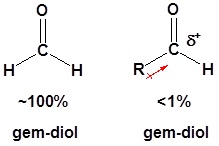
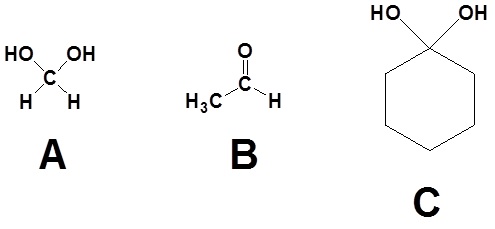
 Exceptions to this rule exist, one being formaldehyde where the weaker pi-component of the carbonyl double bond, relative to other aldehydes or ketones, and the small size of the hydrogen substituents favor addition. 
Thus, a solution of formaldehyde in water (formalin) is almost exclusively the hydrate, or polymers of the hydrate. 
 The addition of electron donating alkyl groups stabilized the partial positive charge on the carbonyl carbon and decreases the amount of gem-diol product at equilibrium.  
Because of this ketones tend to form less than 1% of the hydrate at equilibrium. 
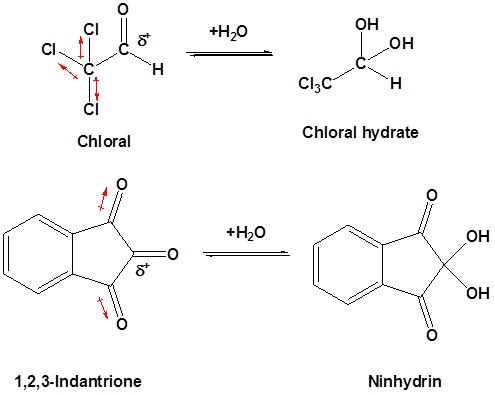
 Likewise, the addition of strong electron-withdrawing groups destabilizes the carbonyl and tends to form stable gem-diols.  Two examples of this are chloral, and 1,2,3-indantrione. 
 It should be noted that chloral hydrate is a sedative and has been added to alcoholic beverages to make a “Knock-out” drink also called a Mickey Finn.  Also, ninhydrin is commonly used by forensic investigators to resolve finger prints.

2a.jpg

3a.jpg


Mechanism of Gem-diol Formation

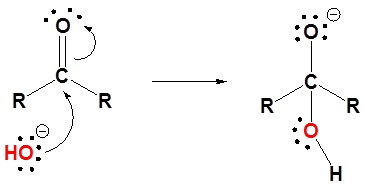
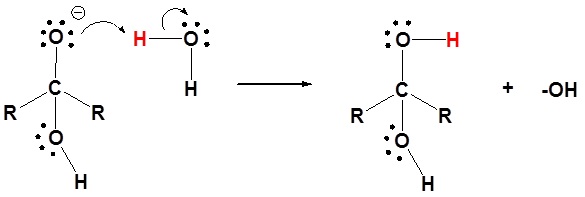
The mechanism is catalyzed by the addition of an acid or base.  Note! This may speed up the reaction but is has not effect on the equilibriums discussed above.  Basic conditions speed up the reaction because hydroxide is a better nucleophilic than water.  Acidic conditions speed up the reaction because the protonated carbonyl is more electrophilic.

Basic conditions
1) Nucleophilic attack by hydroxide
4a.jpg
2) Protonation of the alkoxide

5a.jpg

Acidic conditions
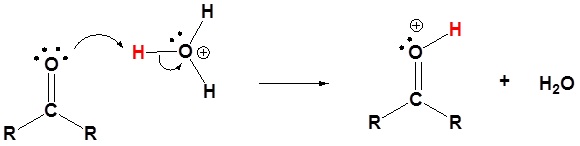
1) Protonation of the carbonyl
6a.jpg
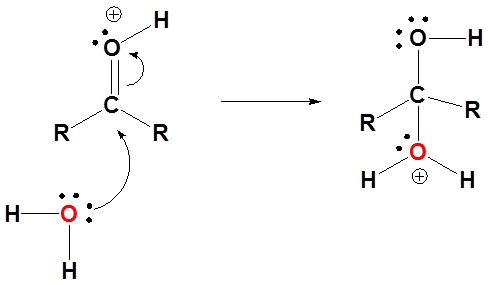
2) Nucleophilic attack by water 
7a.jpg
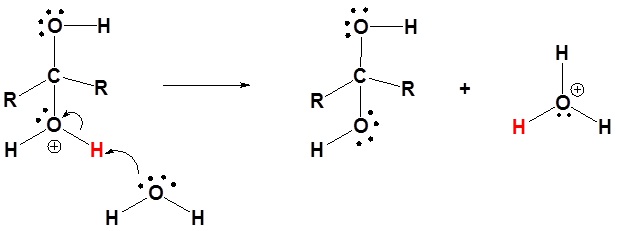
3) Deprotonation
8a.jpg

Problems

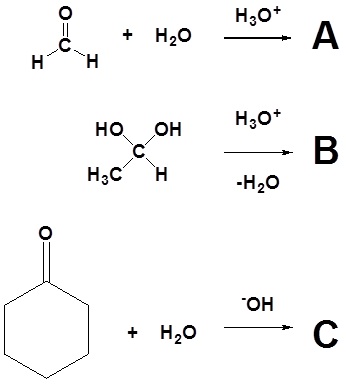
1) Draw the expected products of the following reactions.
11a.jpg

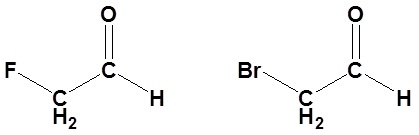
2) Of the following pairs of molecules which would you expect to form a larger percentage of gem-diol at equilibrium? Please explain your answer.
12a.jpg
3)  Would you expect the following molecule to form appreciable amount of gem-diol in water?  Please explain your answer.
13]a.jpg
Answers

1)
14a.jpg
2) The compound on the left would.  Fluorine is more electronegative than bromine and would remove more electron density from the carbonyl carbon.  This would destabilize the carbonyl allowing for more gem-diol to form.
3) Although ketones tend to not form gem-diols this compound exists almost entirely in the gem-diol form when placed in water.  Ketones tend to not form gem-diols because of the stabilizing effect of the electron donating alkyl group.  However, in this case the electron donating effects of alkyl group is dominated by the presence of six highly electronegative fluorines.

Thursday, 1 January 2015

prepration of aldehydes and ketones

Preparing Aldehydes and Ketones


Preparing Aldehydes

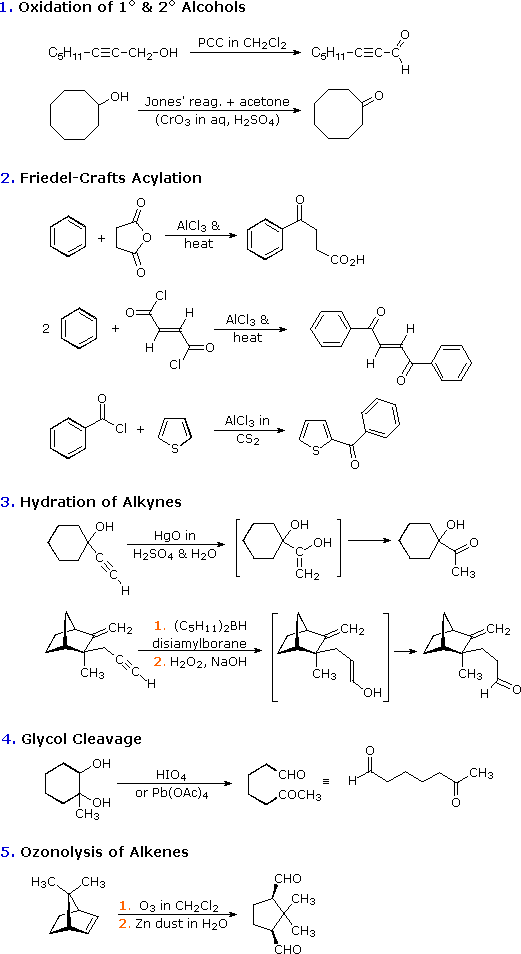
Partial oxidation of primary alcohols to aldehydes

This reaction uses pyridinium chlorochromate (PCC) in the absence of water (if water is present the alcohol will be oxidized further to a carboxylic acid). Alcohol-aldehyde.PNG


mechanism


from alcohols

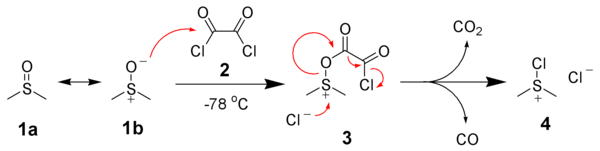
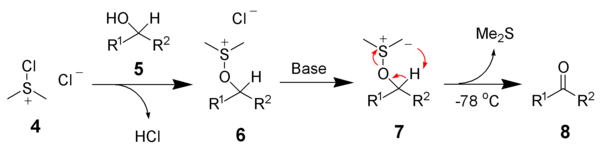
Swern oxidation

The Swern oxidation.

Dimethylchlorosulfonium chloride formation.

The mechanism of the Swern oxidation.


From fatty acids
(HCOO)2Ca + HEAT ----> HCHO + CaCO3 (CH3COO)2Ca + HEAT ----> acetone + CaCO3 (CH3COO)2Ca + (HCOO)2Ca ---->ethanaldehyde

Stephen reduction

StephenSyn.png
mechanism


RCN + SnCl2+ HCL ----> RCH=NH2+Cl− ----> on hydrolysis gives RCHO
Here sulfur is used as a poisoner so that aldehyde formed doesn't get oxidised to the carboxylic acid. See the Wikipedia article for more detail.

Rosenmund reaction

        The Rosenmund reduction


RCOCl + Pd + BaSO4 + S ---->RCHO for solvent xylene is used

Preparing Ketones

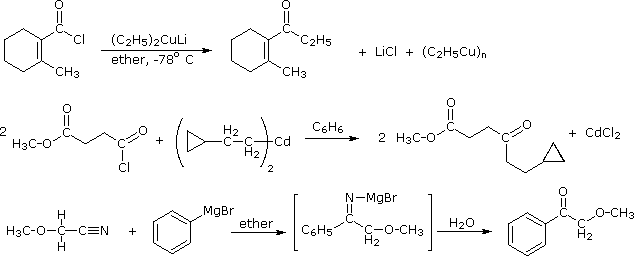
From Grignard reagents

RCOOR' + R'MgX ---->RCOR + R'OH
 

From nitriles

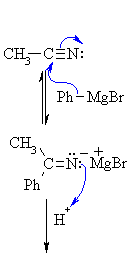
MECHANISM FOR THE REACTION OF RMgX WITH A NITRILE
Step 1:
The nucleophilic C in the organometallic reagent adds to theelectrophilic C in the polar nitrile group. Electrons from theC≡N move to the electronegative N creating an intermediate imine salt complex.
addition of Grignard reagent to an nitrile
Step 2:
An acid/base reaction. On addition of aqueous acid, the intermediate salt protonates giving the imine.
Step 3:
An acid/base reaction. Imines undergo nucleophilic addition, but require activation by protonation (i.e. acid catalysis).
Step 4:
Now the nucleophilic O of a water molecule attacks the electrophilicCwith the π bond breaking to neutralise the change on the N.
Step 5:
An acid/base reaction. Deprotonate the O from the water molecule to neutralise the positive charge.
Step 6:
An acid/base reaction. Before the N system leaves, it needs to be made into a better leaving group by protonation.
Step 7:
Use the electrons on the O in order to push out the N leaving group, a neutral molecule of ammonia.
Step 8:
An acid/base reaction. Deprotonation reveals the carbonyl group ofthe ketone product.


RCN + R'MgX ----> RCOR'(after hydrolysis) HCN does not react with RMgX as HCN has acidic hydrogen which results in RH being formed.

From gem dihalides

RCCl2R + strong base ----> RCOR

Oppenaur oxidation


Oppenauer oxidation reaction scheme

mechanism :

Oppenauer oxidation mechanism


The aluminium-catalyzed hydride shift from the α-carbon of an alcohol component to the carbonyl carbon of a second component, which proceeds over a six-membered transition state, is named Meerwein-Ponndorf-Verley-Reduction (MPV) or Oppenauer Oxidation (OPP) depending on the isolated product. If aldehydes or ketones are the desired products, the reaction is viewed as the Oppenauer Oxidation.
Non-enolizable ketones with a relatively low reduction potential, such as benzophenone, can serve as the carbonyl component used as the hydride acceptor in this oxidation.

Friedel-Crafts acylation of aromatic compounds

Friedel–Crafts acylation overview

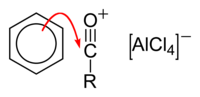
Reaction mechanism

In a simple mechanistic view, the first step consists of dissociation of a chloride ion to form an acyl cation (acylium ion)
FC acylation step 1

FC acylation step II            FC acylation step III

Haworth reaction


Haworth Phenanthrene synthesis


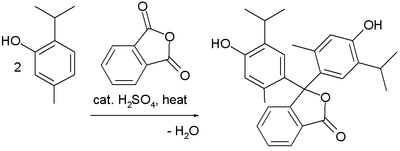
Thymolphthalein Synthesis


Rhodamine B synthesis
An aromatic ring reacts with a carboxylic acid chlorine (RCOCl) in the presence of AlCl3 to form an aryl ketone of the form ArCOR.

Oxidation of secondary alcohols to ketones

A secondary alcohol can be oxidised into a ketone using acidified potassium dichromate(VI) and heating under reflux.
The orange dichromate(VI) ion, Cr2O72-, is reduced to the green Cr3+(aq) ion.

Ozonolysis of alkenes

It is a reaction in which the double bond is completely broken and the alkene molecule converted into two smaller molecules.
A generalized scheme of ozonolysis
Ozonolysis (cleavage "by ozone) is carried out in two stages: first, addition of ozone to the double bond to form an ozonide ; and second, hydrolysis of the ozonide to yield the cleavage products.
Ozone gas is passed into a solution of the alkene in some inert solvent like carbon tetrachloride; evaporation of the solvent leaves the ozonide as a viscous oil. This unstable, explosive compound is not purified, but is treated directly with water, generally in the presence of a reducing agent. If oxidsing reagent is used, aldehyde or ketone if oxidisable can further oxidise into carboxylic acid which is not the case with reducing agents
In the cleavage products a doubly-bonded oxygen is found attached to each of the originally doubly-bonded carbons.
The function of the reducing agent, which is frequently zinc dust, is to prevent formation of hydrogen peroxide, which would otherwise react with the aldehydes and ketones. (Aldehydes, RCHO, are often converted into acids, RCOOH, for ease of isolation.)
Mechanism[edit]
The alkene and ozone form an intermediate molozonide in a 1,3-dipolar cycloaddition. Next, the molozonide reverts to its corresponding carbonyl oxide (also called the Criegee intermediate or Criegee zwitterion) and aldehyde or ketone in a retro-1,3-dipolar cycloaddition. The oxide and aldehyde or ketone react again in a 1,3-dipolar cycloaddition or produce a relatively stable ozonide intermediate (a trioxolane)
The reaction mechanism of ozonolysis.

Hydration of alkynes

Water is added to an alkyne in a strong acid. The strong acid used is sulfuric acid and mercuric acid.